
A little pink in the sink after brushing is something most people shrug off and forget by the time they put the cap back on the toothpaste. That reaction is understandable, but it skips past a question worth asking: why are your gums bleeding at all?

Healthy gums generally do not bleed during routine brushing or flossing. When they do, the body is signaling that something has changed in the tissue. Sometimes the cause is temporary and easy to address. Other times, bleeding is the earliest visible sign of a problem that has been building for a while. Learning to read the signal is the first step toward doing something useful about it.
What Causes Gums to Bleed?
Not every case of bleeding gums causes concern. There are a few routine explanations that come up often and resolve on their own.
Starting a new flossing routine is a common one. Gum tissue that has not been regularly stimulated can be temporarily sensitive. Bleeding that shows up in the first week of consistent flossing and then fades usually falls into this category. The same can happen after a dental cleaning, particularly a thorough one, or when someone switches to a harder-bristled toothbrush.
Other contributing factors include:
- Hormonal shifts during pregnancy, which can increase gum sensitivity
- Certain medications, including blood thinners and some antihistamines, that affect how easily tissue bleeds
- Mouth breathing during sleep, which dries out gum tissue and can make it more fragile
- Vitamin C or vitamin K deficiencies, though these are less common
When bleeding is tied to one of these causes, it tends to be mild, appears in a limited area, and either resolves or stays consistent without worsening. That pattern is different from what happens when gingivitis symptoms or deeper gum disease are involved.
Early Signs of Gum Disease That Start With Bleeding
The earliest signs of gum disease are often easy to miss. There is rarely a dramatic moment where something obviously goes wrong. Patients more often describe a gradual shift: gums that bleed a little during brushing, then start bleeding more easily, then become tender or puffy along the gumline.
Gingivitis, the earliest stage, is driven by plaque buildup along and just below the gumline. Plaque carries bacteria, and when that bacteria is not removed consistently, the surrounding tissue becomes inflamed. The inflammation is what causes the bleeding. At this stage, the damage is limited to the soft tissue and has not yet affected the bone supporting the teeth.
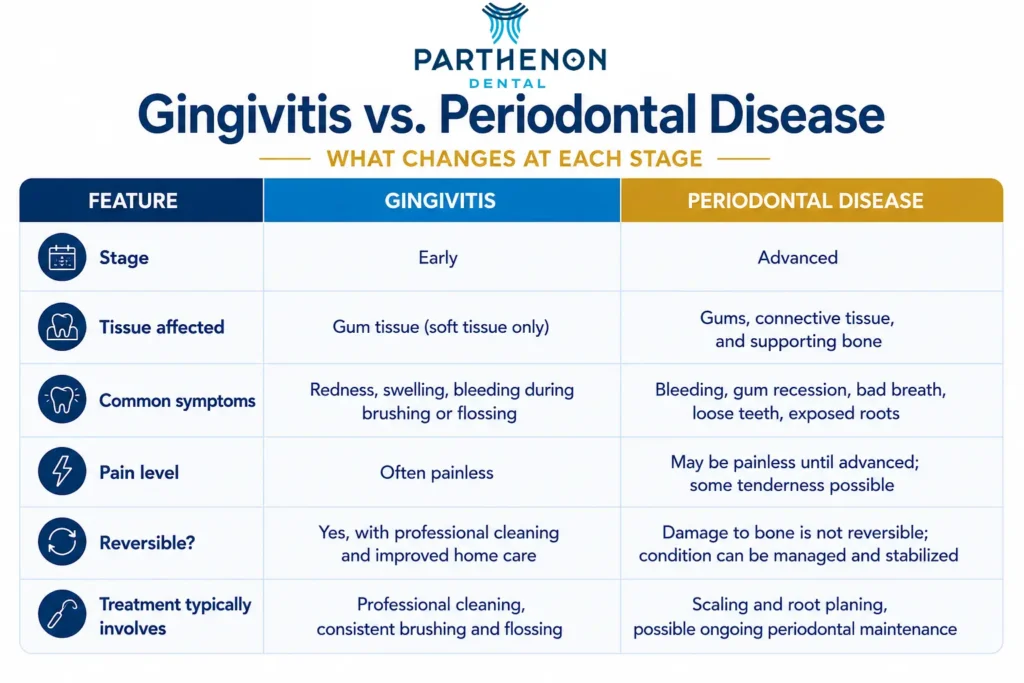
The difference between gingivitis and periodontal disease matters because it affects treatment. Gingivitis is reversible with consistent home care and professional cleaning. Once the infection progresses into the supporting bone and connective tissue, it requires professional intervention. The earlier gum disease is caught, the simpler the path back to stable oral health.
How Gum Disease Progresses Beyond Bleeding
Bleeding is usually the first early sign of gum disease that patients notice, but it is rarely the last. As the condition advances, other signs begin to appear alongside it.
Persistent bad breath is one. The bacteria responsible for gum disease produce sulfur compounds as they break down tissue, and no amount of mouthwash addresses that at the source. Gums that pull away from the teeth, leaving more of the tooth surface exposed, are another indicator. Some patients notice that their teeth feel slightly looser or that their bite has shifted over time.
Many patients are surprised to learn that gum disease can be present in one area of the mouth while other areas look and feel completely normal. A single tooth with significant bone loss can sit right next to a tooth with no attachment issues at all. That uneven pattern means a visual check in the mirror is not a reliable self-assessment. Bleeding in one spot does not mean gum disease is limited to that spot.
What Healthy Gums Actually Look Like
Healthy gums are pink, firm, and fit snugly around the base of each tooth. They do not bleed when touched or brushed with a soft-bristled toothbrush using normal pressure. The texture is sometimes described as stippled, meaning slightly bumpy in appearance — similar to the surface of an orange peel.
Gums that look red rather than pink, feel puffy, or bleed with minimal contact have moved away from that baseline. Swelling and redness are the tissue’s response to bacterial irritation. Bleeding is often the first outward sign of that response.
According to the Centers for Disease Control and Prevention, nearly half of adults aged 30 and older have some form of periodontal disease. Among adults 65 and older, that figure rises to more than 70 percent. Gum disease is not rare — it is common, and it is commonly overlooked in its early stages precisely because bleeding gums have been normalized.
When to See a Dentist for Bleeding Gums
A single episode of minor bleeding after starting a new flossing routine is not something to be alarmed about. But there are patterns that warrant a professional evaluation sooner rather than later.
Schedule an appointment if:
- Gums bleed consistently every time you brush or floss
- Bleeding is happening in the same spot repeatedly
- Gums look swollen, feel tender, or have changed color
- You have noticed a persistent bad taste or bad breath that does not clear up
- Gums appear to be receding or pulling away from the teeth
- You have not had a professional cleaning in more than a year
Any one of these warrants a conversation. Multiple signs together suggest that the tissue has moved past temporary irritation and into something that needs clinical attention.
How to Stop Bleeding Gums Between Appointments
If a dental appointment is already scheduled, there are steps that can help reduce bleeding and inflammation in the meantime. These are not substitutes for professional care, but they matter for daily management.
Brushing technique plays a bigger role than most people realize. Many patients brush with more pressure than necessary, and hard scrubbing actually damages gum tissue over time. The goal is a gentle, circular motion with a soft-bristled brush, angled slightly toward the gumline. Two minutes, twice a day, done consistently.
Flossing is often avoided when gums are already bleeding, but skipping it usually makes the underlying inflammation worse. Flossing removes the plaque buildup between teeth that a toothbrush cannot reach. When done gently and consistently, it typically reduces bleeding over the course of a week or two rather than increasing it.
Additional steps that support gum health include:
- Rinsing with an alcohol-free antibacterial mouthwash to reduce bacterial load
- Staying hydrated, since dry mouth allows bacteria to thrive
- Reducing or eliminating tobacco use, which significantly impairs gum tissue’s ability to heal
- Eating a diet that includes adequate vitamin C, found in citrus, bell peppers, and leafy greens
One point worth noting: smokers often see less bleeding than non-smokers despite having more severe gum disease. Tobacco restricts blood flow to gum tissue, which masks the bleeding signal. Patients who smoke should not interpret low bleeding as a sign that their gum health is fine.

The Link Between Gum Health and Overall Health
Research over the past two decades has established a meaningful connection between periodontal disease and systemic health conditions. Chronic gum infection creates a pathway for oral bacteria to enter the bloodstream. This has been associated with increased risk for cardiovascular disease, poorly managed blood sugar in patients with diabetes, and adverse pregnancy outcomes.
The relationship runs both ways. Uncontrolled diabetes, for example, makes it harder for the body to fight gum infection, and advanced gum disease can, in turn, make blood sugar more difficult to regulate. Patients managing chronic health conditions often find that addressing gum disease is part of a broader conversation about overall wellness, not just an isolated dental concern.
This is part of why dentists ask about medical history and medications during exams. The mouth does not exist separately from the rest of the body, and what happens in the gum tissue can be both a cause and an effect of what is happening elsewhere.
What to Expect at a Gum Disease Evaluation
Patients who come in with concerns about bleeding are typically evaluated with a periodontal probe, a small instrument used to measure the depth of the space between the gum and the tooth. Healthy pockets measure between one and three millimeters. Readings above four millimeters indicate that gum tissue has separated from the tooth, creating a pocket where bacteria accumulates and the immune response cannot easily reach.
X-rays taken during the exam show whether bone loss is present and, if so, how significant. The combination of probing measurements, x-ray findings, and a visual exam of the tissue gives a complete picture of where things stand.
Treatment recommendations depend on what that evaluation shows. For patients in the early stages of gingivitis, a thorough professional cleaning and improved home care is often enough to reverse the condition. For patients with deeper pockets or bone loss, scaling and root planing — a more detailed cleaning done below the gumline — addresses the bacterial buildup at the source. Gum disease treatment is tailored to where the condition is on the spectrum, which is why an early evaluation consistently leads to a simpler path forward.
Gums That Bleed Are Telling You Something
The habit of dismissing bleeding gums as a minor inconvenience is common, and it is understandable. People are busy. The bleeding stops. It happens again next time. And so it goes, sometimes for years, while the underlying condition continues to develop.
Gum tissue that bleeds during brushing is communicating that something in the local environment has shifted enough to provoke an inflammatory response. That response is the body doing its job, but it is also a window — often the first one — into a process that is easier to address at the start than after it has had time to take hold.
Fortunately, the early signs of gum disease are among the most treatable conditions in dentistry. Caught early, gingivitis responds well to consistent home care and professional cleaning. The tissue can return to full health, the bleeding stops, and the underlying bacterial load is brought back under control. Waiting does not make any of that easier — it just shifts what the treatment looks like.
If bleeding gums have become a regular part of brushing or flossing, it is worth finding out why.