At Parthenon Dental, we provide gentle, modern root canal treatment in San Ramon, CA, designed to relieve your pain, save your tooth, and get you back to normal as quickly as possible. If you have searched for root canal providers, our team is ready to help. Root canal procedures may have a poor reputation, but we are committed to making your experience as stress-free as possible.
If you are dealing with tooth pain, swelling, or sensitivity that will not go away, do not wait. An abscessed or infected tooth will not heal on its own. The sooner it is treated, the more options you have, and the more likely we are to save it. Schedule an appointment with our San Ramon office and let us take a look before the problem gets worse.
What Is a Root Canal?

What a root canal comes down to is one basic idea: removing infected or damaged tissue from inside a tooth to save it. Each tooth contains a soft inner layer called the pulp. It holds nerves, blood vessels, and connective tissue. When decay, a crack, or trauma allows bacteria to reach the pulp, it becomes inflamed or infected.
This root canal San Ramon procedure cleans out the infected pulp, disinfects the inside of the tooth, and seals it to prevent reinfection. Your natural tooth is preserved. In most cases, a dental crown is placed over the treated tooth afterward to restore its strength and protect it for the long term.
Without treatment, the infection can spread. It can lead to an abscess, bone loss, or the need for a tooth extraction. According to the American Association of Endodontists, root canal treatment has a success rate above 95 percent, and most treated teeth last a lifetime with proper care. That success rate is part of why saving the natural tooth is almost always the better long-term option when it is possible.
Signs You May Need a Root Canal
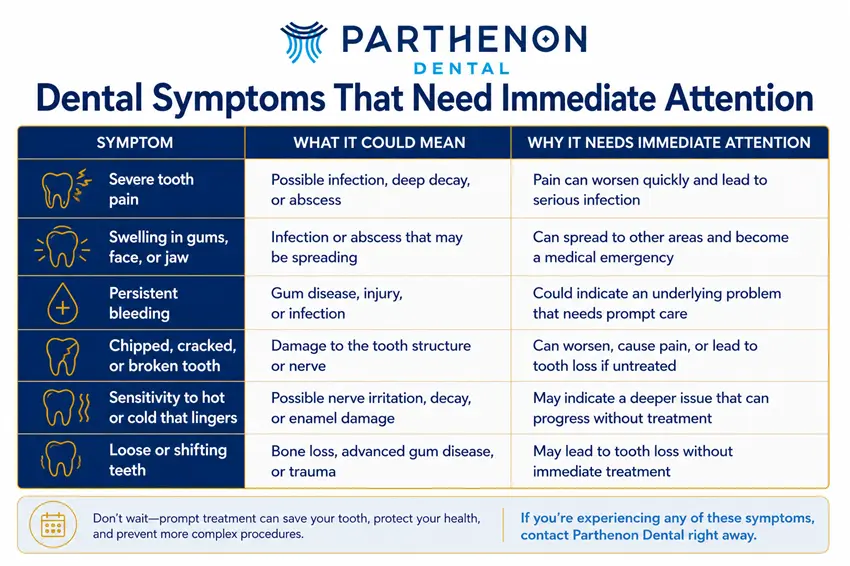
Not every toothache means you need a root canal, but certain symptoms are strong indicators that the pulp is involved. Contact us promptly if you notice any of the following.
- Persistent or severe tooth pain, especially when biting or applying pressure
- Prolonged sensitivity to heat or cold that lingers after the source is removed
- Swelling or tenderness in the gums near a tooth
- A pimple-like bump on the gums, which may indicate an abscessed tooth San Ramon patients often describe when they call us
- Tooth discoloration or darkening
- A cracked or chipped tooth with accompanying pain
These symptoms do not always mean root canal treatment is needed, but they do mean something is wrong, and an exam is necessary. Catching an infection early gives us the best chance of saving the tooth with a straightforward procedure.
When Does a Root Canal Require a Specialist?
Most root canals can be performed safely and comfortably by a general dentist. Straightforward cases, such as a front tooth with a single canal and routine anatomy, are well within the scope of a general dentist’s training. Dr. Niko performs these procedures in our San Ramon office regularly.
Some cases are more complex and may require referral to an endodontist, a dentist who completes two to three additional years of specialized training in root canal therapy. Teeth with unusual root anatomy, significant canal curvature or calcification, or those requiring retreatment are often better managed by a specialist. If we believe your case falls into that category, we will explain why and refer you to the provider best equipped to achieve the best possible outcome. Our priority is making sure you receive the right treatment.
What to Expect During Root Canal Treatment
Root canal treatment is typically completed in one or two appointments at our San Ramon office, depending on the complexity of the case. Most single appointments last 60 to 90 minutes, though more complex cases involving multiple canals or significant infection may need a second visit. We give you a clear timeline during your exam so you can plan accordingly. Here is what the process looks like.
Step 1: Examination and X-Rays
We take digital X-rays to evaluate the extent of the infection and the anatomy of the tooth. Our team uses this information to plan your treatment carefully before anything begins. You will understand exactly what we are doing and why before we start.
Step 2: Anesthesia and Access
We numb the area completely with local anesthesia before beginning. The pain patients associate with root canals is usually the tooth infection itself, not the procedure, and root canal therapy relieves that pain rather than causing it. Sedation options are also available if dental anxiety is a concern. Once you are comfortable, we create a small opening in the top of the tooth to access the pulp chamber.
Step 3: Cleaning and Shaping
Using precise instruments, we remove the infected or damaged pulp and thoroughly clean the inside of each root canal. The canals are shaped to facilitate filling. We use an antimicrobial solution to disinfect the area and eliminate any remaining bacteria.

Step 4: Sealing the Tooth
Once clean, the root canals are filled with a biocompatible material called gutta-percha and sealed to prevent reinfection. A temporary or permanent filling closes the access point. After treatment, the tooth is more brittle than a healthy tooth and needs the protection of a dental crown. We offer same-day dental crowns at our San Ramon office, which means we can often complete your crown in the same visit or a quick follow-up appointment, with no weeks-long wait for a lab.
Most patients feel back to normal within a day or two after treatment. The tooth and surrounding gum tissue may stay tender for a few days, and avoiding hard or crunchy foods on that side while you recover helps. Some mild soreness is common and typically resolves within a few days, manageable with over-the-counter pain relievers. If a crown is being placed, we schedule that appointment once the tooth has healed.
Why Saving Your Tooth With a Root Canal Is Usually the Best Option
Root canal treatment is designed to eliminate infection while preserving your natural tooth. Whenever a tooth can be saved, it is usually the preferred option because it maintains your natural bite, supports the surrounding teeth, and helps preserve the jawbone.
Removing a tooth often creates the need for additional treatment, such as a dental implant or bridge, to restore function and prevent neighboring teeth from shifting. Those treatments are effective but involve more time and expense.
With proper care, a tooth treated with a root canal can last for many years, and often a lifetime. If a tooth cannot be saved, we will explain why and discuss the replacement options that best fit your needs.

Root Canal Cost and Insurance in San Ramon
The cost of root canal treatment depends on which tooth is being treated and how many root canals it contains. Front teeth typically have a single canal and are generally less expensive to treat than molars, which often have three or four canals and require more time and precision.
Most PPO dental insurance plans provide partial coverage for root canal treatment because it is considered a medically necessary procedure rather than a cosmetic one. Before treatment begins, our San Ramon team will verify your insurance benefits and provide a written estimate, so you know what to expect. If you do not have dental insurance, we also offer flexible financing options.
Emergency Root Canal Care in San Ramon
A severe toothache or dental abscess is a dental emergency. Infections do not resolve on their own and can spread quickly if left untreated. Patients searching for root canal treatment near San Ramon can contact our office, and we will work to see you as soon as possible.
Our office sits just off San Ramon Valley Boulevard, a few minutes from City Center Bishop Ranch, which makes same-day and next-day emergency visits genuinely convenient for patients across the area. We regularly see patients from Dougherty Valley, Crow Canyon, Gale Ranch, Windemere, and other neighboring communities.
Schedule Your Root Canal Appointment in San Ramon
Ignoring tooth pain rarely makes the problem better. If you have persistent pain, swelling, sensitivity, or signs of an infection, seeking treatment early gives you the best chance of saving your natural tooth and avoiding more extensive dental work.
At Parthenon Dental, we use modern techniques and effective anesthesia to make root canal treatment as comfortable as possible. Our team will identify the source of your pain, explain your treatment options clearly, and answer your questions before moving forward. Whether you need a routine root canal or an evaluation to determine the cause of your symptoms, we are here to help.
If you are looking for trusted root canal treatment in San Ramon, contact Parthenon Dental today to schedule your appointment. The sooner an infected tooth is treated, the sooner you can get back to eating, speaking, and smiling comfortably.

 925-718-8483