

A child who cries at the sight of a dental chair is not being dramatic. Their nervous system is reacting to something that genuinely looks and sounds alarming from a smaller vantage point, surrounded by unfamiliar tools and adults leaning in close. Kids’ dental anxiety is one of the most common reasons families delay checkups, and it is almost always manageable once the specific triggers are understood.
How Common Is Dental Anxiety in Children?
This is not a rare or unusual reaction. A global meta-analysis published in the International Journal of Paediatric Dentistry found that nearly one in four children and adolescents experience meaningful dental anxiety, with the rate climbing to more than a third among preschool-age children specifically. Dental anxiety in children tends to fade somewhat with age as kids build more visits and better coping tools, but for younger children it is closer to the norm than the exception.

What a Child Afraid of the Dentist Is Actually Reacting To
A child afraid of the dentist is rarely reacting to pain itself, especially on a first or early visit. More often, the fear comes from a combination of unfamiliar sounds, a loss of control over what happens next, and having someone lean in close to their face and mouth, which is an unusual amount of physical closeness from a stranger. The whir of a drill or suction tool two rooms away can sound far more threatening to a child than it actually is, simply because they cannot see what is making the noise.
A few specific triggers show up again and again:
- Equipment sounds, particularly the suction tool and any drilling noise
- Lying back in a reclined chair, which removes a sense of control
- Bright lights and unfamiliar smells in the treatment room
- Separation anxiety if a parent is asked to wait outside during part of the visit
Pediatric Dental Anxiety Tips That Actually Work
Most effective pediatric dental anxiety tips come down to giving a child a sense of control and predictability, rather than trying to distract them from what is happening. A technique many pediatric dentists rely on is often called tell-show-do. The dentist explains what a tool does in simple terms, lets the child see and sometimes touch it outside their mouth, and only then uses it. That small sequence turns an unknown object into something the child has already met, which measurably reduces fear compared to skipping straight to the procedure.
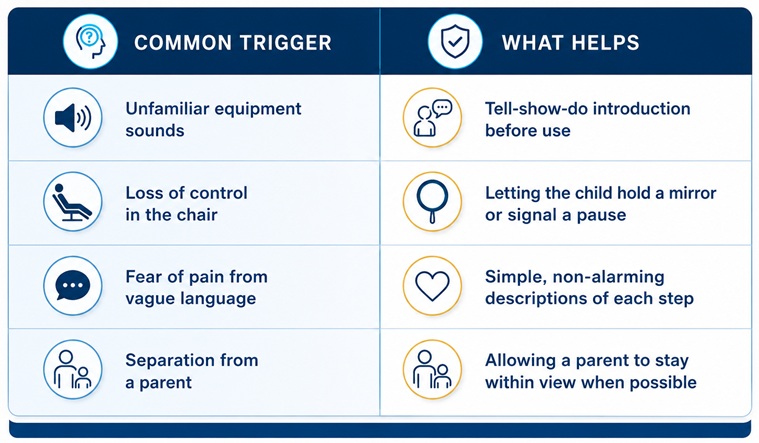
Word choice matters more than most parents realize. Dental teams trained in pediatric care tend to avoid words like “shot,” “drill,” or “hurt,” replacing them with softer, more concrete language a child can picture without alarm. This is not about being dishonest. It is about describing the same sensation in terms that do not trigger a fear response before anything has even happened.
Preparing Your Child for the Dentist Before the Appointment
Preparing your child for the dentist in the days beforehand makes a bigger difference than anything said in the waiting room. Reading a children’s book about visiting the dentist, or playing a simple pretend version at home with a toothbrush and a stuffed animal, gives a child a mental script to follow once they are actually in the chair. Avoid last-minute reassurances like “it won’t hurt,” since that phrase introduces the idea of pain the child may not have been thinking about otherwise.
Scheduling matters too. A morning appointment, before a child gets tired or hungry, tends to go more smoothly than one squeezed in after a long day.
Making Dental Visits Easier for Kids During the Appointment

Making dental visits easier for kids once they are in the chair often comes down to small, practical choices. Letting a child bring a comfort item, hold a hand mirror to watch what is happening, or listen to music through headphones gives them something familiar to anchor to during an unfamiliar experience. Positive reinforcement after the visit, rather than a bribe offered beforehand, tends to build a better long-term association, since a reward promised in advance can unintentionally signal that something difficult is coming.
Parents staying calm and neutral in the room also matters more than most realize. Kids pick up on a parent’s own tension quickly, and an anxious parent in the room can reinforce a child’s fear even without saying anything.
How to Reduce Fear of the Dentist in Children Over Time
Learning how to reduce fear of the dentist in children over the course of several visits, not just one, is where lasting progress happens. Seeing the same dentist and team consistently builds familiarity that a new office each time cannot replicate. Short, low-pressure visits early on, even ones that involve nothing more than counting teeth and taking a quick look, help a child build a track record of visits that were not scary, which makes the next one easier by default.
Consistency also lets a dental team build a real behavioral history with a specific child, noticing what worked last time and adjusting the next visit accordingly rather than starting from scratch.
What to Expect at a Child-Friendly First Dentist Visit
A well-run first dentist visit for kids is intentionally brief and low-stakes, often scheduled around a child’s first birthday per guidance from the American Academy of Pediatric Dentistry. The goal of that early visit is not a thorough exam. It is building a first positive association before any treatment is ever needed. Child-friendly dental care at this stage usually means a quick look in the mouth, a simple explanation of what a healthy smile looks like, and plenty of encouragement, without pushing for more than the child is ready for that day.
For kids with especially strong anxiety, some practices offer options like nitrous oxide for shorter, calmer visits during more involved treatment. Families interested in that option can ask about sedation dentistry to see whether it fits a particular child’s needs, particularly for a procedure that would otherwise be difficult to sit through calmly.
Dental anxiety in children is not something most kids simply grow out of on their own. It responds to specific, repeatable strategies, from how a visit is explained beforehand to how a dentist paces the exam once a child is in the chair. Families who treat each visit as a chance to build familiarity, rather than just getting through it, tend to see fear ease noticeably within a few appointments.
None of this requires a dramatic intervention. Small, consistent choices, a calm parent, a dentist who explains before doing, and short early visits that ask little of a nervous child, add up over time into a kid who no longer dreads the chair.
Schedule your child’s next visit with a team that specializes in easing dental anxiety at every age.