
Babies start sucking their thumbs before they are even born, which tells you something about how deeply this reflex is wired into early development. Thumb sucking and pacifiers are not bad habits in the way a parent might instinctively assume. They are a normal way infants self-soothe, explore their surroundings, and manage the everyday stress of being a very small person in a very large world.
The concern most dentists actually watch for is not whether a child sucks their thumb or uses a pacifier. It is how long the habit lasts and how intensely it continues once permanent teeth start getting ready to arrive. A one-year-old with a pacifier is doing exactly what is developmentally expected. A five-year-old with the same habit is a different conversation, and knowing where that line falls helps parents know when to relax and when to take action.
Thumb Sucking and Pacifiers: What’s Actually Normal
According to guidance published in the Journal of the American Dental Association, most children stop sucking their thumb or fingers on their own somewhere between ages two and four, without any intervention needed. The habit tends to fade gradually as kids spend more of their waking hours occupied with talking, playing, and exploring, rather than needing the same self-soothing reflex they relied on as infants.

When to Stop Thumb Sucking
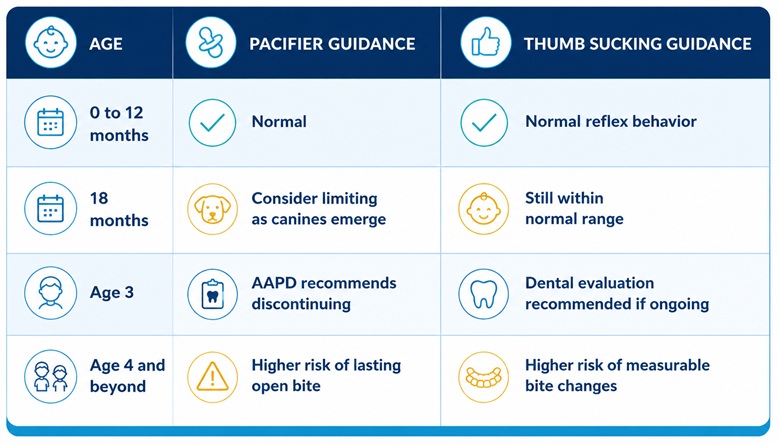
Most guidance on when to stop thumb sucking points to around age three as the point where a persistent habit is worth a conversation with a dentist. The American Academy of Pediatric Dentistry recommends active discouragement and a dental evaluation if thumb sucking continues past that age, since the risk of lasting dental effects increases the longer the habit persists into the years when permanent teeth are developing underneath the baby teeth.
- Ages 2 to 4: Normal range for the habit to fade naturally on its own
- Age 3: Point where dental professionals recommend paying closer attention
- Age 4 and beyond: Higher likelihood of measurable effects on tooth and jaw alignment
When to Stop Using a Pacifier
The guidance around when to stop using a pacifier is slightly more specific than thumb sucking, mainly because a pacifier is easier for most families to phase out entirely. Research reviewed by the AAPD found that pacifier use lasting 36 months or longer was associated with a significantly higher rate of anterior open bite, a gap between the upper and lower front teeth that does not close when the mouth is shut. Some pediatric dentists recommend limiting or discontinuing pacifier use around the time the canine teeth emerge, roughly 18 months, specifically to reduce the risk of a posterior crossbite developing later.
Effects of Thumb Sucking on Teeth
The effects of thumb sucking on teeth depend heavily on how the habit is carried out, not just how long it lasts. A gentle habit that mostly involves resting the thumb near the mouth affects the bite differently than an aggressive, forceful sucking pattern. Prolonged pressure against the front teeth and the roof of the mouth can gradually push upper teeth forward, narrow the palate, and create the same type of open bite associated with extended pacifier use.
Pacifier Effects on Teeth vs Thumb Sucking
Here is something worth knowing that most parents never hear explicitly. Research on pacifier effects on teeth compared to finger habits has found that thumb and finger sucking is more strongly associated with increased overjet and a specific bite pattern called Class II malocclusion than pacifier use is. Part of the reason comes down to control. A pacifier applies fairly consistent, predictable pressure, while a thumb can be pushed against the teeth with varying force and angle that a child adjusts without realizing it, sometimes creating more targeted pressure on specific teeth.
Recognizing Thumb Sucking Dental Problems

Thumb sucking dental problems are not always obvious in the early years, since baby teeth are more forgiving and some shifting corrects itself once the habit stops. A few signs are worth watching for regardless of a child’s age:
- An open bite where front teeth do not touch when the mouth is closed
- A noticeably narrow or high roof of the mouth
- Upper front teeth angling forward more than expected
- Changes in speech, particularly with sounds that require the tongue and teeth to meet properly
How to Stop Thumb Sucking
Figuring out how to stop thumb sucking usually works better through positive reinforcement than through punishment or shame, since the habit is rooted in comfort rather than defiance. Identifying when the habit shows up most, often during tiredness, boredom, or stress, gives parents a chance to offer another form of comfort at those specific moments rather than trying to eliminate the behavior across the board all at once. A reward system tracking sucking-free stretches of time tends to work better than criticism when a lapse happens.
For children who have tried and struggled to stop on their own, a dentist can offer additional tools, from a simple reminder appliance to a conversation framed in a way that resonates better coming from someone other than a parent.
Prolonged Thumb Sucking: When to See a Dentist
Prolonged thumb sucking past the age of four, particularly if it is frequent, forceful, or showing any of the visible signs mentioned earlier, is worth bringing up at a routine checkup rather than waiting to see if it resolves on its own. Catching a developing bite issue early often means a simpler intervention than waiting until permanent teeth have already been affected by years of consistent pressure.
Pediatric Dental Habits Worth Monitoring Beyond Sucking

Thumb sucking and pacifier use are two of the most common pediatric dental habits dentists monitor, but they are not the only ones. Mouth breathing, tongue thrust during swallowing, and nail biting can all influence how a child’s bite develops over time in similar ways. Routine checkups give a dentist the chance to catch these patterns early, well before a parent would necessarily notice anything themselves.
Most thumb sucking and pacifier habits resolve on their own without ever becoming a dental issue, and treating every instance as an emergency does more harm to a child’s stress levels than good. The habit itself is not the problem. Duration, intensity, and timing relative to permanent tooth development are what actually determine whether intervention becomes necessary.
Parents who feel unsure whether a habit has gone on too long do not need to guess. A quick look during a regular checkup can confirm whether a child’s bite is developing normally or whether it is worth addressing the habit sooner rather than later. Families interested in establishing that kind of routine monitoring early can learn more about pediatric dentistry and what a typical checkup schedule looks like for young children.
Schedule a checkup to get a clear answer on where your child’s habit stands and whether it is time to address it.