

If you want to improve your smile, you have probably come across two popular options: composite bonding vs veneers. Both dental treatments can fix chips, gaps, discoloration, and uneven teeth, but they are not the same treatment. The right choice depends on your goals, your budget, and the condition of your tooth.
This guide breaks down the key differences so you can walk into your appointment already knowing the basics.
What Is Composite Bonding?
Composite bonding uses a tooth-colored composite material to reshape or repair a tooth. Your dentist applies the material directly to the surface and sculpts it by hand. It hardens under a special light and blends in with your natural enamel.
The process is usually done in one visit. No impressions, no lab work, and in most cases, no anesthesia. It is one of the most accessible options in cosmetic dentistry because it requires very little preparation. It is also less invasive than veneers, making it appealing for patients who want to keep things simple.
What Are Porcelain Veneers?
Porcelain veneers are thin ceramic shells bonded to the front of your teeth. They are custom-made in a dental lab to match your desired shape and color. Unlike composite veneers, porcelain shells provide complete front-surface coverage for a more uniform look. The process typically takes two to three visits.
At the first appointment, your dentist removes a thin layer of enamel. Impressions are taken and sent to the lab. You wear temporary veneers while your permanent dental veneers are crafted. When they are ready, they are bonded permanently to your teeth.
Because enamel removal is involved, veneers are more expensive than bonding and are considered an irreversible dental procedure.
Comparing the Two: A Side-by-Side Look
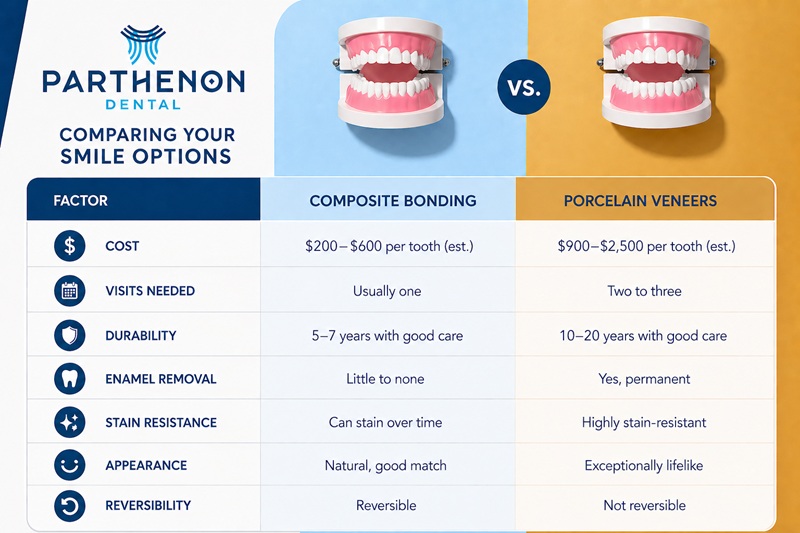
Cost: What Should You Expect to Pay?
The cost for dental bonding is generally much lower than the cost of porcelain veneers. Bonding typically runs a few hundred dollars per tooth. Veneers cost several times more per tooth, and most patients treat multiple teeth at once.

That said, veneers tend to last longer. Over ten to twenty years, the cost per year may actually be comparable. It depends on how many teeth you are treating and how well you maintain them.
Insurance rarely covers either option since both are cosmetic. Financing can help with veneers, so ask your dental team about payment plans.
Durability: Which One Holds Up Better?
When it comes to the durability of dental bonding over porcelain veneers, veneers win. Veneers can last fifteen to twenty years or more with proper care. Bonding typically lasts five to seven years before it may need a touch-up or replacement.
Bonding composite is more prone to chipping and staining. Porcelain is harder and resists discoloration well. However, composite bonding is easier to repair if something does go wrong. A small chip can often be fixed in a single appointment. A damaged veneer usually requires a full replacement.
Appearance: How Do They Look?
Both options look natural when done well. The difference comes down to refinement and light reflection.
Porcelain mimics the way real enamel catches light. It has a translucency that the same material used in composite resin does not fully replicate. For a dramatic transformation or a full smile makeover, veneer and bonding comparisons almost always favor porcelain for overall appearance.
Dental bonding still looks great for small repairs. For a single chipped tooth or minor corrections like a small gap, it is often undetectable. The result depends heavily on your dentist’s skills.
Best Option for Chipped Teeth
If you are looking for the best option for chipped teeth, bonding is often the first recommendation. It is quick, affordable, and very effective for small to moderate chips. Your dentist can reshape the tooth in one appointment and send you home the same day.
For more severe damage or if you want to improve multiple teeth at the same time, porcelain veneers may be a better fit. They provide complete front-surface coverage and deliver more comprehensive results.
Who Is a Good Candidate for Composite Bonding?
Composite bonding works best for patients who:
- Have minor chips, cracks, or small gaps that need minor corrections
- Want a fast, affordable fix
- Prefer a reversible treatment
- Are looking to repair one or two teeth rather than transform a full smile
- Have generally healthy teeth and gums
It is also a good option for younger patients who are not ready to commit to an irreversible procedure. The benefits of bonding include low cost, fast results, and easy repair if anything changes down the road.
Who Is a Good Candidate for Porcelain Veneers?
Veneers dental treatment is a better fit for patients who:
- Want a long-lasting, dramatic smile transformation
- Have multiple cosmetic concerns across several teeth
- Are dealing with significant discoloration that whitening cannot fix
- Have slightly misshapen or uneven teeth
- Are committed to maintaining their results long-term
Veneers are not ideal if you grind your teeth heavily. Bruxism can crack porcelain over time. Your dentist may recommend a night guard to protect them if grinding is a concern.
When One Is Clearly the Better Choice
Choose bonding if you want a simple, same-day fix for a minor issue. Choose veneers if you are ready for a permanent upgrade and want results that last well over a decade.
Some patients start with composite bonding and later transition to dental veneers, while others go straight to veneers because their goals are bigger from the start.
Either way, the right answer starts with a conversation with your dentist. A quick exam and a few photos can point you in the right direction fast.
Frequently Asked Questions
Is composite bonding or veneers better for a chipped tooth?
For a single chipped tooth, composite bonding is usually the faster and more affordable choice. It can be completed in one visit and blends in naturally with the surrounding tooth.
How long do veneers last compared to bonding?
Porcelain veneers typically last ten to twenty years with proper care. Composite bonding usually lasts five to seven years before it may need a repair or replacement.
Do dental bonding or veneers cost less?
Composite bonding costs significantly less upfront, often a few hundred dollars per tooth. Veneers cost more per tooth but may offer better long-term value given their durability.