
Finding a crack in a tooth raises an immediate question: how worried should you be? The size of a crack is actually one of the least reliable ways to judge how significant it is. A fine line visible on the surface can sometimes threaten the tooth. A more obvious crack in a different location might need nothing more than monitoring. The assessment involves factors that are not visible from a mirror and a lot of light. This post explains what those factors are and what they typically mean for treatment.
If you have noticed something that looks like a crack and are unsure what to make of it, that is worth mentioning at your next visit — or scheduling a look sooner if you are already having symptoms.
Not All Tooth Cracks Work the Same Way
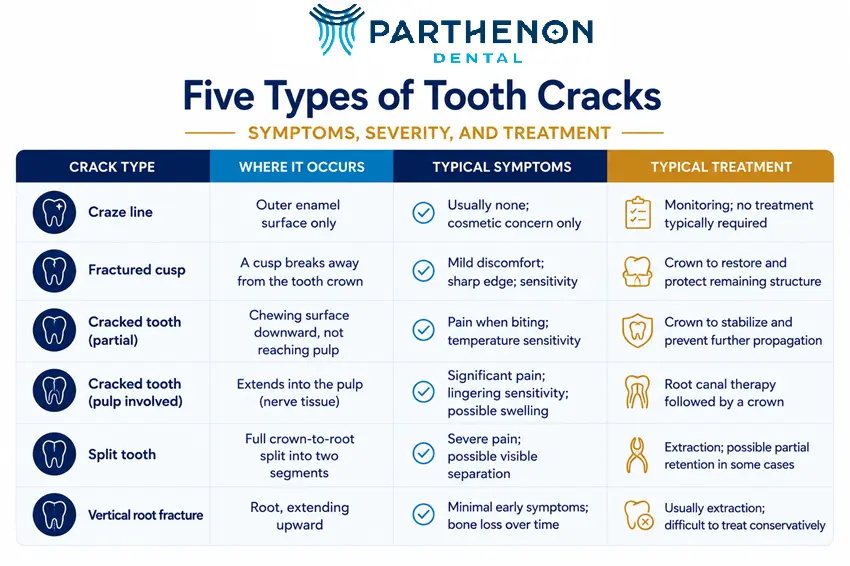
Dentistry uses specific terminology to describe different types of tooth cracks, and those categories correspond to different levels of concern. Understanding them helps explain why a dentist might treat two cracks very differently, even when they look similar from the outside.
Craze Lines
Craze lines are tiny, superficial cracks that affect only the outer enamel layer. They are extremely common in adults and largely a normal response to years of temperature changes, biting forces, and the natural aging of enamel. A craze line that causes no symptoms and does not extend below the enamel surface is generally not a structural concern. It does not indicate a tooth in danger of splitting or an increased risk of decay at that location.
They often become visible under strong lighting or when light catches the tooth at a certain angle. In the absence of symptoms, they typically require nothing more than monitoring.
Fractured Cusp
A fractured cusp involves one of the pointed areas at the top of a molar or premolar breaking away from the rest of the tooth. This often happens around an existing filling, where the surrounding natural tooth structure is thinner and more vulnerable to fracture. A fractured cusp exposes more tooth structure and can create pathways for bacteria, so it usually requires a crown or other restoration to protect what remains. The good news is that a cusp fracture typically does not involve the pulp — the inner nerve tissue — so root canal treatment is often not needed.
Cracked Tooth
A cracked tooth in the clinical sense is a crack that begins at the chewing surface and extends downward toward the root. This is where the severity range becomes significant. A crack that extends partially into the tooth but has not reached the pulp can often be treated with a crown that holds the tooth together and prevents the crack from going further. A crack that reaches the pulp involves the nerve and requires root canal treatment in addition to a crown. A crack that extends below the gumline is a more serious situation and may mean the tooth cannot be saved.
Split Tooth
A split tooth is what happens when a crack progresses until the two segments can be separated. A split tooth cannot typically be saved intact. Depending on where the split ends, one portion may sometimes be retained with specialized treatment, but that is not always possible.
Vertical Root Fracture
A vertical root fracture begins in the root and extends upward. These are often the hardest cracks to diagnose because they may produce minimal symptoms early on and are not visible on standard X-rays. They tend to be discovered when surrounding bone loss becomes apparent or when an infection develops. Vertical root fractures almost always result in extraction because the fracture runs through the foundation of the tooth.
What Symptoms Actually Reveal About a Crack
Symptoms guide a crack evaluation as much as anything visible. The location of pain or sensitivity, what triggers it, and whether the discomfort lingers all give information about how deep the crack likely extends and whether the nerve is involved.
Pain when biting down that releases when pressure is lifted is a classic sign of a cracked tooth. The flex of the crack during biting stimulates the nerve, and the momentary relief when the bite releases is distinct from the steady ache of a cavity. Sharp pain when eating something cold or hot that resolves quickly can indicate early sensitivity. Pain that lingers for more than a few seconds after the trigger is removed suggests the nerve tissue is inflamed — which means the crack has likely reached or is close to the pulp.
How Dentists Evaluate a Crack
Because cracks are not always visible on X-rays, dentists use several tools to assess what is happening. Cracks typically run parallel to the X-ray beam, so they often do not appear even on a clean film. A normal X-ray does not rule out a significant crack.
Several diagnostic methods help get a clearer picture:
- Transillumination — A high-intensity light shone through the tooth makes the crack visible against the background.
- Bite stick testing — The patient bites on a small instrument on different cusps to isolate where discomfort originates.
- Dye staining — A temporary stain applied to the tooth makes cracks visible under magnification.
- Magnification and loupes — Allow close examination of the crack’s path and how far it extends.
- X-rays — Useful for ruling out decay, bone loss, and root involvement, though not reliable for seeing cracks directly.
Can a Cracked Tooth Heal on Its Own?

No — not in the way a bone might knit back together. Tooth structure does not regenerate. A crack in enamel or dentin stays there. What changes over time without treatment is the crack’s behavior: it may stay stable, or it may extend further under the repeated stress of biting and chewing.
This is why timing matters. A crack treated while it is still confined to the crown of the tooth often has a good prognosis. The same crack left alone may require more involved care or progress to the point where the tooth cannot be restored. The challenge is that cracks can worsen without a clear warning. Symptoms that come and go are easy to put aside, but intermittent discomfort from a crack can become more consistent as it progresses.
According to the American Association of Endodontists, cracked teeth are one of the leading causes of tooth loss in industrialized nations, and cracked tooth syndrome can be difficult to diagnose because symptoms often appear inconsistently. [1]
What Puts Teeth at Higher Risk for Cracking
Cracks rarely happen at random. There are usually contributing factors that put a tooth under more stress than it was built to handle over time.
- Teeth grinding and clenching — The sustained force of bruxism is one of the most consistent contributors to tooth fracture, particularly in back teeth.
- Large existing restorations — A tooth with a large filling has less natural structure remaining around it, making the remaining walls more vulnerable to cracking under load.
- Biting hard objects — Ice, hard candy, unpopped popcorn kernels, and using teeth as tools all create sudden high forces that can initiate or extend a crack.
- Temperature extremes — Repeated rapid changes, like eating something very hot followed immediately by something cold, stress enamel over time.
- Age — The cumulative effect of years of chewing, temperature cycling, and dental work makes cracks more common in older teeth.
- Trauma — A direct blow from a fall, sports injury, or accident can fracture a tooth immediately.
How Cracked Teeth Are Treated

Treatment depends entirely on the type and extent of the crack. There is no single answer, and the right approach for one patient may be completely different from what another needs.
For a craze line with no symptoms, the treatment is often nothing beyond monitoring. For a fractured cusp or a crack that has not reached the pulp, a crown is typically used to protect the tooth from further fracture and restore its function. For a crack that has reached the pulp, root canal therapy addresses the nerve involvement before a crown is placed. For a crack that extends below the gumline or a split tooth, extraction followed by a dental implant or bridge is often the path forward.
The earlier a crack is identified and treated, the more options are available. A crack caught before it reaches the pulp avoids the need for root canal treatment entirely. A crack caught before it goes below the gumline avoids extraction. Those are meaningful differences in both complexity and cost.
When to Get a Crack Checked
Sharp pain when biting, sensitivity that comes and goes without an obvious explanation, or something that visually looks like a crack are all worth a look. Those symptoms do not always mean something serious, but they are the kind of thing that gets easier to address early than after it has had time to develop.
Tooth cracks can sound alarming, and some of them are serious. But most people who come in concerned about a crack leave with a clearer picture and a manageable plan. The five-category framework above is how dentists think about them. Not all cracks are equal, and the treatment follows from what kind it actually is and how far it has progressed.
If something has been bothering you or you have noticed a line on a tooth, that is a reasonable reason to schedule an evaluation and find out what you are dealing with.